Drop off the south end of Mukilteo Boulevard and the city disappears faster than it has any right to. Forest Park covers 197 acres on that slope, which makes it the largest park Everett owns, and the ravine trails inside it fall away steeply enough that traffic noise is gone within a couple of switchbacks. The neighbourhood that takes its name from the park sits just below and east of it.
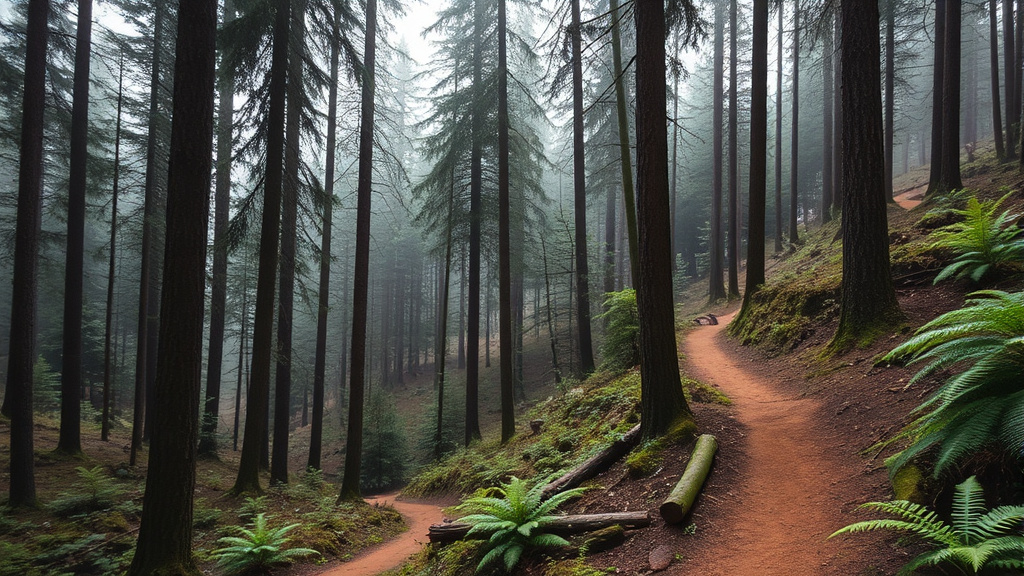
197 acres bought ten at a time
Everett picked up the first ten acres of this ground on 27 September 1894 and kept buying. Another eighty acres were in city hands by 1909, and the name Forest Park was settled on in 1913. The address is 802 E Mukilteo Blvd, and the gates follow the same six in the morning to dusk pattern as the rest of the city's parks.
Three things in the park outlast any given season. Floral Hall, the exhibition building from the Works Progress Administration era, opened in 1940 and is listed on the National Register of Historic Places. The swim centre opened to the public in 1975, took storm damage in 1984 and was rebuilt as a permanent structure the following year, and it still runs lessons and lap swims through the year. The animal farm is the one that brings families up the hill, free to walk through and open across the summer months, with goats, sheep, rabbits, ducks, chickens and horses.
For anyone who treats the park as training ground rather than a day out, the hill climb network is the draw. Thirteen mapped routes can be strung together into something close to five miles with well over a thousand feet of climbing, and there is a gentler ridge trail along the top for people who would rather not do that. Everett Transit routes 3 and 18 both reach the park, and parking does not cost anything.
The neighbourhood below the park
South Forest Park is drawn by the city with 41st Street and Mukilteo Boulevard across the top, Evergreen Way down the eastern side, and a southern line that runs along Pecks Drive, picks up the west side of Fleming, crosses at 52nd and meets Pigeon Creek Number 1. That same creek closes off the western edge. Woodlawn Gardens and the creek corridor itself are the other pieces of green inside those lines, and the association keeps a community garden going.
Its housing is genuinely mixed, which is unusual for Everett. Turn-of-the-century bungalows sit near mid-century single-storey homes, multi-family buildings and newer construction, often on the same street. The neighbourhood association meets at Zion Lutheran Church at 47th and Alger, usually the second Tuesday of the month though not every month, and the restaurants and small shops along Evergreen Way are what most residents mean when they talk about going out locally.
What a creek ravine does to the plumbing above it
Ground that falls toward Pigeon Creek changes the arithmetic on drains and supply lines. Houses on the slope often sit on crawl spaces rather than full basements, with supply lines running through vented space that gets genuinely cold in a Puget Sound cold snap and genuinely damp the rest of the year. Two patterns follow from that.
The first is freezing. A hose bib left connected through a hard freeze, or an uninsulated run crossing an open crawl space, is the common failure here rather than anything exotic. The second is age. Bungalows from the early decades were plumbed in galvanised steel and cast iron, and where those runs have never been replaced they narrow from the inside until pressure drops and drains slow. On a hillside lot a slow drain is harder to read, because gravity can mask a partial blockage until it stops working altogether.

Knowing the shutoff before you need it
The single most useful thing a resident on this slope can do costs nothing. Find the main shutoff, confirm it actually turns, and make sure more than one person in the house knows where it is. In these older homes it is usually in the crawl space near the front of the building or close to the water heater, and there is a second valve at the meter by the street. A valve that has not been exercised in twenty years sometimes will not close when it matters, and that is much better to discover on a dry Sunday than at two in the morning with water coming through a ceiling.
After-hours response is worth understanding before you are shopping for it under pressure. Any contractor advertising round-the-clock work is describing a dispatch arrangement, not a van parked on your street, and the practical questions are who actually answers the phone at three in the morning, whether the person who arrives can do the repair or only stop the leak, and what the call-out terms are. Reading through how residents rate local after-hours plumbers before anything breaks is a reasonable hour to spend, as is checking what separates a well-run repair outfit from a dispatcher.
Licensing is the other check. Plumbing and electrical are separate licences in Washington, and a firm that holds both has had to qualify for each. That combination has become slightly more common locally, which is what Danika Plumbing & Electric Adds Licensed Electricians to Its Everett, WA Plumbing Team describes, an Everett plumbing contractor trading since 2009 bringing licensed electricians onto its own team. On a flooded crawl space that overlap is not academic, because a failed pump or a soaked junction box turns one trade's problem into the other's.
Driving down from Forest Park to Airport Road
From the Forest Park entrance on Mukilteo Boulevard, the Danika Plumbing & Electric shop on Airport Road is a short run south and east across the neighbourhood. This route runs from the park gates to their door.
Danika Plumbing & Electric · 11015 Airport Rd, Everett, WA 98204 · (425) 374-1557
The ravine is the reason this neighbourhood looks the way it does, and the reason its houses were built in so many different decades. Water has been running down that slope toward the creek a great deal longer than any of the pipework above it.